
Tooth Chart & Numbering Guide (1–32)
Texadent Texas, Houston
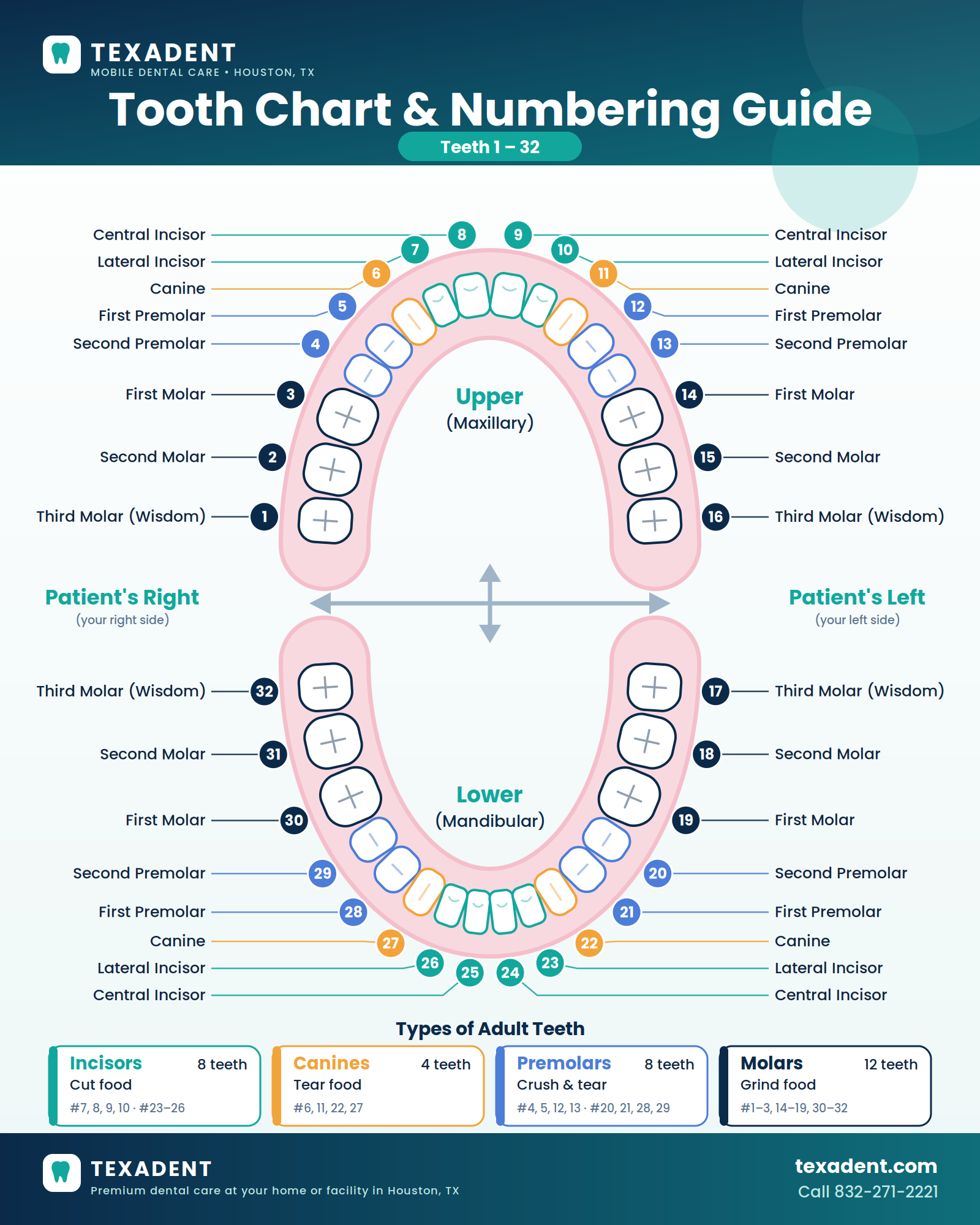
A tooth chart is a diagram that labels every tooth in your mouth with a number or letter. In the United States, adult teeth are numbered 1 to 32 (the Universal Numbering System), starting at the upper right wisdom tooth (#1), moving across the top to the upper left wisdom tooth (#16), then dropping to the lower left wisdom tooth (#17) and finishing at the lower right wisdom tooth (#32). Baby teeth use the letters A to T.
Ever heard your dentist call out “number 19, occlusal” and wondered what it meant? That is the tooth chart at work. Dental teams use it to record exactly which tooth has a cavity, a crown, or a planned treatment, quickly and without confusion.
At Texadent Mobile Dental Care, we bring dentistry to patients across Houston, TX, so understanding your chart helps you follow your care plan wherever you receive it, whether that is at home, at a care facility, or anywhere else we visit. This guide explains how the system works, how to read it, and why it matters.
What Is a Tooth Chart?
A tooth chart (also called a dental chart or tooth numbering chart) is a map of your teeth. Each tooth has a unique number or letter, so your dentist, hygienist, and insurance provider all refer to the same tooth every time.
Dentists use it to:
-
Record cavities, fillings, crowns, bridges, implants, and extractions
-
Track gum health and tooth movement over time
-
Plan treatment such as root canals or dentures
-
Submit accurate insurance claims
How the Tooth Numbering System Works (Adult Teeth)
Most US dental offices use the Universal Numbering System. Adults normally have 32 permanent teeth, numbered like this:
-
Start: Tooth #1 is the farthest back tooth on your upper right side.
-
Across the top: Numbers rise toward the front and across to the upper left, ending at #16.
-
Drop to the bottom: Tooth #17 is the farthest back tooth on your lower left side.
-
Across the bottom: Numbers continue toward the front and across to the lower right, ending at #32.
A simple memory trick: picture yourself reading a book. You begin at the top right of your mouth (from your dentist’s view, the top left), travel across, then drop down a line and travel back.
Adult Tooth Chart: Numbers and Names
Types of Teeth and What They Do
An adult mouth has four types of teeth, each with its own job:
- Incisors (8 teeth): Sharp front teeth that cut food. Numbers 7–10 and 23–26.
- Canines (4 teeth): Pointed teeth that tear food. Numbers 6, 11, 22, and 27.
- Premolars (8 teeth): Flat-topped teeth that crush and tear. Numbers 4, 5, 12, 13, 20, 21, 28, and 29.
Molars (12 teeth, including wisdom teeth): Large back teeth that grind food. Numbers 1–3, 14–19, and 30–32.
Baby Teeth Chart (Primary Teeth A–T)
Children have 20 primary teeth, labeled with letters instead of numbers:
- A to J: Upper teeth, from the upper right back molar (A) to the upper left back molar (J)
- K to T: Lower teeth, from the lower left back molar (K) to the lower right back molar (T)
Primary teeth usually begin to appear around six months of age, and most children have their full set by about age three. Permanent teeth then replace them gradually from around age six into the early teens, and wisdom teeth typically arrive between roughly 17 and 21 (timing varies from person to person).
Other Tooth Numbering Systems
Not every dental record uses the 1–32 system. You may also see:
FDI World Dental Federation notation (ISO 3950): Used in many countries. It uses two digits: the first shows the quadrant (1 = upper right, 2 = upper left, 3 = lower left, 4 = lower right) and the second shows the tooth position from the center (1 to 8). For example, tooth 18 is the upper right wisdom tooth, which is #1 in the Universal system.
Palmer notation: Uses a grid symbol to show the quadrant plus a number from 1 to 8, common in orthodontics and some dental schools.
If you move, travel, or receive records from abroad, knowing these systems helps you avoid mix-ups.
How to Read Your Dental Records
When your dentist says “tooth 14, mesial-occlusal composite,” here is what it means:
-
Tooth 14: Upper left first molar
-
Mesial: The side facing the front of your mouth
-
Occlusal: The chewing surface
-
Composite: A tooth-colored filling
Other surface terms you may see: distal (toward the back), buccal (cheek side), lingual (tongue side), and facial (lip side of front teeth).
Why Knowing Your Tooth Numbers Matters
Clearer conversations: You understand your treatment plan and can ask better questions.
Accurate records: Fewer errors between providers, specialists, and insurers.
Better follow-up: You can track which teeth need attention and monitor changes.
Confidence for caregivers: Family members helping a loved one can follow dental notes easily.
Mobile Dentistry in Houston, TX: Care That Comes to You
Understanding your tooth chart is one thing. Getting to the dentist is another. For many people, including older adults, people with mobility challenges, busy families, and anyone who finds travel stressful, regular dental visits fall through the cracks.
That is where mobile dentistry helps. A mobile dentist brings professional equipment and care to your location, so your teeth are examined, charted, and treated without the stress of a clinic trip.
At Texadent Mobile Dental Care, our Houston team documents your dental chart carefully, explains each finding in plain language, and helps you plan next steps. If you have questions about a tooth number on your records, we are happy to walk you through it.
Ready for dental care without the commute?
Call Texadent Mobile Dental Care at 832-271-2221 or visit texadent.com to learn more about mobile dentistry in Houston, TX.

Frequently Asked Questions
Most adults have 32 permanent teeth, including four wisdom teeth. Some people have fewer because wisdom teeth were removed, never developed, or other teeth were lost.
Tooth number 1 is the upper right third molar, also known as the upper right wisdom tooth, from the patient’s perspective.
The Universal system numbers teeth 1 to 32 and is standard in the United States. The FDI system uses a two-digit code (quadrant plus tooth position) and is widely used internationally.
Children have 20 primary teeth, labeled A through T on a dental chart.
Incisors, canines, premolars, and molars. Each is shaped for a different task, such as cutting, tearing, or grinding food.
Yes. A mobile dentist can perform exams, record findings on your dental chart, and recommend treatment, all at your location. Contact Texadent at 832-271-2221 to confirm which services fit your needs.
Numbers are faster and clearer than long names, which reduces errors in records, referrals, and insurance claims.